


Aotearoa Before Us III: Our Undergrowth
- Joseph Nicholson
- Apr 10
- 15 min read


As we walk into the bush, we hear the crunch of dried leaves under our feet, and the sloshing of mud. Today we are finally moving into Aotearoa’s most prominent habitat—our forests. Our most diverse habitat, covering over 80% of Aotearoa at this time.
There is so much to talk about that we have to break it down into two parts, and today we are covering what lives under the trees—under our feet in the leaf litter and understory of pre-human Aotearoa.
In the dim light of the understory, we see the movement of a small animal scurrying along the forest floor, almost like a mouse. But remember, the only land mammals of Aotearoa are bats… so this cannot be.
We follow the movement and then find the culprit—a small flightless bird. It looks like a Lyall's wren (Traversia lyalli), also known as the Stephens Island wren. In our time, it's a bit of a conservation icon, as it survived until the 1890s on Stephens Island until cats were introduced and wiped out the last population.
In this time they lived all across Aotearoa. They were common on the forest floor, sharing this area with a host of other species.

At 30 grams, this wren dwarfs the Rifleman / Tītitipounamu (Acanthisitta chloris) and Rock Wrens / Pīwauwau (Xenicus gilviventris), but is dwarfed by another wren… that has just come over, scaring our Lyall wren away.
This wren is the North/South Island stout-legged wren (Xenicus jagmi / yaldwyni), and at 50 grams, it's the largest of the wrens in Aotearoa. Debate exists on if it's one species or two, but the main difference is that the South Island species is larger than the North Island species—a common trend in our birds.
These birds were truly unique species, as they all belong to the largest group of birds, the Passeriformes, or perching birds, that include our wrens, our honeyeaters, ravens, sparrows etc with over 6,000 species worldwide.
Only 4 or 5 species within this group became flightless, and the majority of these birds are from Aotearoa, with these wren species and the long billed wren, which we will talk about in a later blogpost. The only other flightless passerine is the Long-legged bunting (Emberiza alcoveri) from the Canary Islands off the North African coast.
This shows how rare this is in nature, and with all of them now extinct, how vulnerable they are to extinction.
We then hear some light booming and crashing in front of us as we move over to a small creek to see a group of Little bush moa / Moariki (Anomalopteryx didiformis) foraging along the bank.
This species is the smallest of all 9 moa species and at 1.3 meters tall and 30kgs, not that much larger than a turkey. They were also the most common too, found in every forest habitat.
They have rounded heads and a short, stubby, rounded bill, eating up all the twigs, ferns and other tough plant material on the forest floor. Their movements though the undergrowth startles insects, with species like Tomtit / Miromiro (Petroica macrocephala) and North/South Island Robins (Petroica longipes / australis), just like hikers today, showing it's not only species that go extinct, it's the relationships between them too.

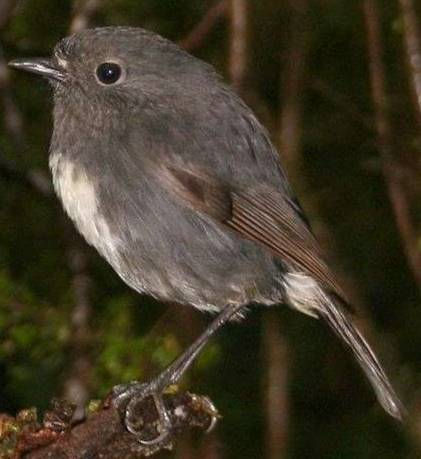
The almost idyllic silence is then broken as the air goes still and the birds go startled as a large bird of prey manages to come down and snag one of the younger bush moa, as the others scatter and disappear into the forest.
When the dust settles, the bird is revealed to be an Eyles' harrier / Kērangi (Circus teauteensis). This is one of the apex predators of Aotearoa, with a 2 meter wingspan and weighing up to 3 kilos, and was the largest bird of prey in the North Island, and second only to Haast's eagle (Hieraaetus moorei) in the South Island.
Bucking the trend, the North island birds were larger, with no competition for the top predator role. Their main prey would have been smaller birds like Kereru or Kaka, but this large female can kill prey up to 40kgs, which she managed today with a young Little bush moa.
Their closest relative is the Spotted Harrier (Circus assimilis) from Australia and has a 1.4 m wingspan and at 700g grams. This is a textbook example of insular gigantism, when animals get isolated on islands then become larger to take advantage of the new resources, becoming the top predators of Aotearoa.
Sadly predators like these are often the most sensitive to extinction, with Polynesians competing for prey, habitat loss and the kiore eating their eggs, these were likely one of the first extinctions after human arrival.
After another stroll, we then see the familiar shape of a Weka (Gallirallus australis), rooting though looking for Powellphantina snails.

These carnivorous snails are today under immense pressure from introduced predators like rats, possums and pigs but common in this time, and are dealing with their natural predators. The Weka stabs them clean then eats the contents of the shell.
This level of predation is what the snails can handle, but with the introduction of these mammals they struggle to keep up, and also means the Weka populations have to compete with them for more limited food, leaving less food for everyone as the snails decline.
We decide to look through the undergrowth turning logs and rocks, finding many small animals like slaters and peripus worms, species familiar to us, but one animal sticks out
among the others hanging out on a fern.
Turns out… It is a Fern Weevil (Tymbopiptus valeas), known from Waitomo, this Weevil is quite large, nocturnal and flightless, the most vulnerable to these introduced predators and likely went extinct due to Kiore and habitat destruction.
We decide to head back to the moa kill to see if the female harrier is still feeding but when we get there we find a very different bird scavenging on the carcass.
The bird looks almost like one of the dead moas it was moving with, but its colours are off. It pulls its head out of the moas body to show a blood-caked head with a much longer and pointer beak. This gives it away as a North/South Island Azdebill (Aptornis otidiformis / defossor).
While they look superficially like a Moa, standing at 80cm tall and 18 kilograms, how they fit on the family tree was a mystery until DNA studies showed they were an ancient family of rails, with their closest living relatives being the flufftails, found mostly in Africa and
Madagascar.
Like the stout legged wren, they are sometimes considered the same species, but the South island species tends to be about 20% larger. These birds were omnivorous unlike herbivorous moa, with isotope studies showing they fed on large insects, reptiles and even small birds almost like a giant weka, so this is normal behaviour for this bird to scavenge.
Like the moa, these birds were hunted into extinction.
We then hear the sounds of a beautiful birdcall, unlike any other bird we are familiar with. We follow the call and find some North/South Island Piopio or New Zealand Thrush (Turnagra tanagra / capensis).
These birds managed to survive until 1905, so the differences between the species is more clear. Both are about 26 cm long and about 130 grams but the North Island species has a uniform white throat and a greyish-white breast and belly while the South Island species has bold brown and white streaks on its underparts, and its throat and the sides of its neck had a reddish-brown tinge.
The South island species also has what was considered the most beautiful song compared to the other birds of Aotearoa, and both species could mimic like Tui and parrots.
These birds were omnivores and fed on the forest floor, feeding on leaves, small invertebrates, berries and even caught flying insects on the wing. These birds sadly declined after the Europeans came, and the North island species was last seen in 1902 and the South island species in 1905.

As the sun continues to set, we look for probe holes in the ground and one of the potential culprits as he probes into the ground looking for food.
This bird is a Snipe-rail (Capellirallus karamu) and while it may look like a little kiwi, it's actually a type of rail, similar to a banded rail, which it is slightly larger than at 240gs, its got a long 7cm bill and lot of similar adaptations to kiwi, allowing it find food in a similar way.
Its small wings and long legs suggest it was terrestrial, and remains have only been found in closed forest habitats in the North Island.
Foraging next to them are smaller species of smaller kiwi looking birds; these are North/ South Island Snipe (Coenocorypha barrierensis / iredalei), also known as the Tutukiwi.
These snipes were found all over Aotearoa, and the genus ranged up to New Caledonia and Fiji, but now only two species remain, the Chatham snipe (C. pusilla) and the Subantarctic Snipe (C. aucklandica).
The North Island species was 20 cm and 90g in weight, having a larger buff-white patch on the chin/throat and finer, lighter breast markings while the South Island snipe was slightly larger at 22cm and 95 grams along with a darker chest band.


They probe in the ground not like Kiwis or the Snipe-Rail looking for worms and other soil dwelling invertebrates. They at least both manage to survive into European times, with the
last North Island snipe being found in the 1870s on Te Hauturu-o-Toi / Little Barrier Island and the South Island species up until the 1960s, when rats invaded Taukihepa / Big South Cape Island.
As the daylight starts to wane, the night sets in, with a lot of wildlife being nocturnal to avoid the sharp eyes of the daytime predators of Aotearoa.
We start to hear the calls and the crashing of kiwi as they emerge from the burrows to feed. The first species we see is the Little Spotted Kiwi / Kiwi pukupuku (Apteryx owenii), the
smallest kiwi species.
Once the most common species they were found all over Aotearoa but being the most vulnerable kiwi species to introduced predators due to their size. Males range from 0.9 to 1.36 kg while females range from 1 to 1.9 kg, with even adults being lucky to make past the 1.2 kg “stoat proof” threshold.
They declined until there were only 7 birds left, and they had to be put on predator-free offshore islands to ensure their safety and even today their numbers only number less than 2,000, a shadow of their former numbers.
The North Island population, sometimes considered their own subspecies (A.o. iredalei), were critically endangered at the time of European settlement, with the last being found on Pirongia in 1882. Although these kiwi were under so much pressure, a small population managed to hang on in the South Island after being thought extinct there since 1978, showing their resilience.

We then see a larger kiwi pushing through the undergrowth and scaring off the smaller bird. It may look like a typical brown kiwi, but the smaller size and pinkish beak gives it away as an Okarito brown kiwi / Rowi (Apteryx rowi).
This kiwi is the rarest of all, with only 600–800 left in the Okarito forest on the West Coast of the South Island. Historically though it was found from the southern North Island up to Hawke’s Bay and Wairarapa, then from Nelson and the West Coast of the northern parts of the South Island.
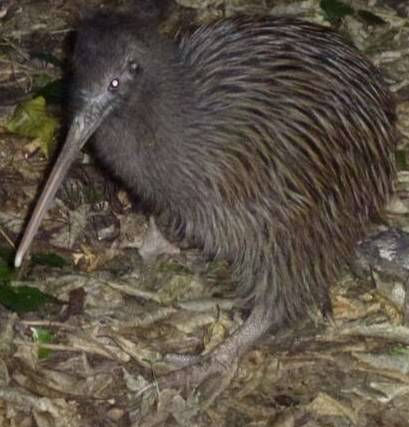
In this time, this kiwi is common in these areas, and forms an interesting “probing guild” with the previously mentioned species, all sharing the forest by probing at different depths into the ground. The North/South Island snipe could reach about 45 mm, snipe-rail to 56 mm, little spotted kiwi to 80 mm, and brown kiwi to 130 mm, avoiding competition for food resources.
Now we decide to turn on our flashlights and go scoping around any ponds to find some of the least well known extinct animals of Aotearoa—our frogs.
We first manage to spot one swimming in the water, but it looks way too large and bulky to be the Hochstetter's frog / Pangokereia (Leiopelma hochstetteri), looks to me like a Markham's frog (L. markhami).

This frog seemed to be quite large and robust, with a snout-to-vent length of 50–60 mm, and likely lived a similar lifestyle to the Hochstetter's frog, coming out at night around these covered pools feeding on all kinds of small, invertebrate prey.
These guys were found all over Aotearoa, and the Hochstetter's ranged on the South Island’s west coast as well. A close relative, the Aurora frog (L. auroraensis) was found in Aurora Cave, Fiordland and was endemic to the South Island but was broader than even the bulky Markham's frog.
As we search by torchlight we spot an even larger frog again, but looks very similar to an Archey's frog / Pepeketua (Leiopelma archeyi) but dwarfs even the largest frogs of modern Aotearoa the Hamilton's frog / Pepeketua (L. hamiltoni).

This seems to be a Waitomo frog (L. waitomoensis). This frog is massive, and with a snout-to-vent length of 100mm is double the size of any of Aotearoa’s native frogs and only matched by the introduced Australian Southern bell frog (Ranoidea raniformis).
This species would have been more terrestrial, living in the leaf litter and short shrubs of the forest of the North Island. All these frog species have been impacted severely by introduced mammals, driving the larger species to extinction and restricting the modern ones to small ranges.
We then see an Archey's frog / Pepeketua (Leiopelma archeyi) moving not far along in our search. Quickly after spotting it though, a bird flies over as they come quickly and pin the frog under its talons and swallows it.

Its forward facing eyes, rictal bristles and long le
gs give it away as a New Zealand owlet-nightjar / Ruru hinapō (Aegotheles novaezealandiae). This is a giant of its group at 35 cm long and 250 grams, its longer legs and shorter wings suggesting that it was more terrestrial than other owlet-nightjars and was a common nighttime predator of the forests of Aotearoa, eating insects and other small animals.

This bird likely went extinct with the arrival of the kiore.
Looking on the ground as we walk along, we also see a lot more reptiles in the understory, either sitting near burrows or on logs and branches hunting.
The Tuatara (Sphenodon punctatus), the last survivors of the Rhynchocephalians (“beak-heads”) that first appeared in the Middle Triassic, around 244 million years ago. They lived worldwide and peaked during the Jurassic, declined during the Cretaceous and went extinct outside Aotearoa in the Paleocene (61mya).

In this time, they were all over Aotearoa, not relegated to fenced mainland sanctuaries or offshore islands like today. We see a large male waiting for food to come his way outside his home, an abandoned kiwi burrow.
We see this trend continue as we find skink species common on the ground that today can be only be found on offshore islands or small populations, like the Robust skink (Oligosoma alani), Chevron skink / Niho taniwha (O. homalonotum), McGregor's skinks (O. macgregori) and the Whitaker's skink (O. whitakeri).

One skink we have seen tonight is different though, looks like a Robust skink, but with a wider and long head, and is twice as large as one, even though it's today the largest skink of Aotearoa.
This skink is called the Northland skink (O. northlandi) and is the only extinct skink from Aotearoa. While very similar to the Robust skink, it had a longer, narrower face and was much larger in size, comparable to the Land Mullet (Bellatorias major) of Australia, one of the largest skinks of all at 50cm in length.
Northland skinks have only been found in Northland, suggesting it was only found there, meaning its range was restricted, and made it all the more vulnerable to extinction.
As we carry on looking along the twisting roots of the trees we find Wood Rose (Dactylanthus taylorii) or Te pua o te rēinga the “Flower of the underworld”.
These are the only fully parasitic flowering plants in Aotearoa and attach themselves to the roots of podocarp trees. The flowers of these look like pasty white roses and were pollinated by the Kākāpō (Strigops habroptilus) but today rely on New Zealand short-tailed bats (Mystacina).

Both the Lesser short tailed bats (Mystacina tuberculata) and the wood rose have declined due to harvesting, browsing/hunting by introduced mammals and habitat loss caused them all to decline.
Speaking of bats, we see one flying onto one of the Wood roses. It looks larger with bigger ears than the Lesser short-tailed bats, so this reveals it to be a Greater short-tailed bat (Mystacina robusta).

Very similar, this was originally just a subspecies of the Lesser short-tailed bat until 1982, 17 years after the last confirmed sighting.
In this time, the Greater short-tailed bat was found all over Aotearoa, but in the 20th century was only found on Taukihepa / Big South Cape Island and Rerewhakaupoko / Solomon Island off the coast of Stewart Island / Rakiura and possibly went extinct after rats got to these islands in the 1960s.
Some reports suggest this species may be still alive in small numbers on these islands and are considered one of 25 "most wanted lost" species of Global Wildlife Conservation's "Search for Lost Species" initiative, but if they are alive, they are clearly in dire need of help.
Luck does not seem to be on the side of the bat as a silent bird of prey catches it within its talons and takes it to a high perch.
We shine the light to show this to be the distinct lighter patterning of the Laughing owl / Whēkau (Ninox albifacies). A close relative of the Morepork / Ruru (N. novaeseelandiae) but twice the size, it got its name from its distinctive call, described as a “prolonged cack-cack-cack” like laughter.

This bird is the nighttime apex predator of Aotearoa, feeding on small to medium-sized birds, frogs, bats, lizards, juvenile tuatara, and larger insects.
Unlike the ruru, the Laughing owl preferred to nest on the ground in caves and rock ledges, meaning eggs and incubating mothers were not safe when mustelids like ferrets and stoats were introduced to Aotearoa in the 1880s, and the laughing owl went extinct not long after in the 1940s.
As we head back to our tent to sleep for the night, we see a two legged shape outside our tent, almost like someone was breaking in. Couldn't be someone else… surely we are the only ones here.
After we shine the light, the animal reveals itself as a Broad-billed moa (Euryapteryx curtus). This moa was one of the most common, with a stout body and a broad bill, found all over Aotearoa.
While they preferred open areas, they were often seen in forests like this and to avoid competing with other moa for food, these moa ate the softer leaves and fruits of shrubs and other plants.
Like the other species of moa, they were all vulnerable to human hunting and the habitat loss that followed after human arrival.
This curious moa finds no food to be found here and decides to move on, allowing us to get into our tent and fall asleep to the soundscape of nightfall in pre-human Aotearoa.
We see a trend among a lot of these animals. Some tend to be larger, some tend to be flightless, all tend to breed slowly. That’s what makes introduced mammals so detrimental to the ecosystems of Aotearoa.
Before them, all the predators were hunting by vision, so to combat this, many animals were brown or green, nocturnal, and often stood still when they thought they were spotted, relying on camouflage.
Many animals also lived long lives and bred slowly, with our frogs living 30 years, our lizards and birds up to 60, and our tuatara up to 150 years, meaning predation pressure was much lower.
This all changed when introduced mammals came. Mammals like rats and mustelids have great senses of smell, allowing them to find eggs or small animals easily—like a kiwi chick hiding in a burrow.
It’s like our birds are ill prepared for them, because they lost the behaviours needed to deal with predators like these over millions of years.
That’s why predator control in Aotearoa is so important.
In areas with no control, native wildlife declines. The survival rate of kiwi chicks in these areas is only 5 percent, or 1 in 20, and it takes predator control efforts to allow these numbers to reach 95 percent—a much more natural number.
This is why initiatives like Predator Free 2050 are so important. With control and eradication of introduced mammals, species we still have can make a comeback to areas they once roamed.
They were always adaptable and in tune with their environments—we just threw them a curveball.
This view into the past could also be our future. If Kiwis put in the money and the mahi, we could once again have our undergrowth dense with endemic wildlife
References
Home page | New Zealand Birds Online. (n.d.). Www.nzbirdsonline.org.nz. https://www.nzbirdsonline.org.nz/
Watts, C. H., Marra, M. J., Green, C. J., Hunt, L. A., & Thornburrow, D. (2019). Comparing fossil and extant beetles in central North Island forests, New Zealand. Journal of the Royal Society of New Zealand, 49(4), 474–493. https://doi.org/10.1080/03036758.2019.1597380
Worthy, T. H. (1987). Osteology of Leiopelma( Amphibia: Leiopelmatidae) and descriptions of three new subfossil Leiopelma species. Journal of the Royal Society of New Zealand, 17(3), 201–251. https://doi.org/10.1080/03036758.1987.10418160
Worthy, T. H. (1991). Fossil skink bones from Northland, New Zealand, and description of a new species of Cyclodina , Scincidae. Journal of the Royal Society of New Zealand, 21(4), 329–348. https://doi.org/10.1080/03036758.1991.10420831
Dactylanthus taylorii. (2022). New Zealand Plant Conservation Network. https://www.nzpcn.org.nz/flora/species/dactylanthus-taylorii/
O'Donnell, C. 2021. Mystacina robusta. The IUCN Red List of Threatened Species 2021: e.T14260A22070387. https://dx.doi.org/10.2305/IUCN.UK.2021-1.RLTS.T14260A22070387.en. Accessed on 27 March 2026.
Predator Free NZ Trust. (2016). Predator Free NZ. https://predatorfreenz.org/


I enjoyed looking through this article and found several points worth thinking about. Bubble Shooter
Beautiful exploration of Aotearoa’s undergrowth and the life hidden within it wacky flip. The way this piece highlights the quiet complexity of the forest floor makes the ecosystem feel even more alive.
If you enjoy games that reward careful control instead of speed, eggy car is worth trying. It's easy to start playing but takes practice to improve your distance.
It's fascinating to learn about Aotearoa's diverse habitats and the unique creatures that inhabit them. On another note, I recently found a great resource for understanding more about different types of games and their mechanics at scritchy scratchy.
One of the most valuable messages from this article is the reminder that wetlands provide benefits far beyond wildlife conservation. They act as natural water filters, help reduce flooding, store carbon, and support healthy rivers and remove people from background lakes. In a world facing climate change and environmental degradation, wetlands are among nature’s most effective solutions. Their ability to absorb and slowly release water makes them essential for maintaining ecological balance and protecting communities from extreme weather events. Articles like this help readers understand that preserving wetlands is not only about saving species—it is about safeguarding entire ecosystems and future generations.