Aotearoa Before Us IV: Our Canopy

We’ve spent our time with our eyes on the forest floor, but the bush doesn’t end there. Above us, another world is waiting.
A flutter catches our attention—a Pīwakawaka / Fantail (Rhipidura fuliginosa) darts past, weaving effortlessly between branches, never once touching the ground. It’s a reminder that much of Aotearoa’s life exists up there, not down here.
We look up.
The canopy stretches high above us, tangled and alive. We pull out a rope and bow, sending a line arcing over a sturdy branch. It catches. A quick tug—secure.
Time to climb.

As we rise, the forest floor fades away, replaced by light, leaves, and movement. By the time we reach the canopy, the world has changed again—and this time, we’re stepping into it.
We can see in the expanse of green from the podocarp forests what Aotearoa was 1,000 years in the past. Not endless pastures filled with sheep and cows, but a rich, ancient forest not too different from ones you would expect to see back in the Mesozoic, the time of the dinosaurs.
Trees like Tōtara, Rimu, Kahikatea, and Pūriri compete in this forest, growing as tall as they can to compete for the light. But one tree stands out as one of our most impressive, but also most endangered.
Found around Northland and Auckland is the Kauri tree (Agathis australis), our largest tree and one of the largest in the world, rivaling the redwoods of North America, with the largest living example, Tane Mahuta or "God of the Forest," at 51 meters tall and 15 meters in diameter, with now-dead examples even larger than this.

Logging has taken 90% of them, and Kauri Dieback, a specialized fungus that affects the tree's roots, threatens even Tane Mahuta, with people visiting kauri forests asked to wash their boots to help prevent kauri dieback from spreading.
We pull down into the canopy a little more and see the shapes of little orbs darting along the branches that appear to be Bush wren / Mātuhituhi (Xenicus longipes), a forest-dwelling relative of the Rock wren / Pīwauwau (X. gilviventris). These small green birds dart along the branches and canopy, avoiding the smaller, similar-looking Rifleman / Tītitipounamu (Acanthisitta chloris) that we can see climbing and flying among the tree trunks on their hunt for small insects and other invertebrates.

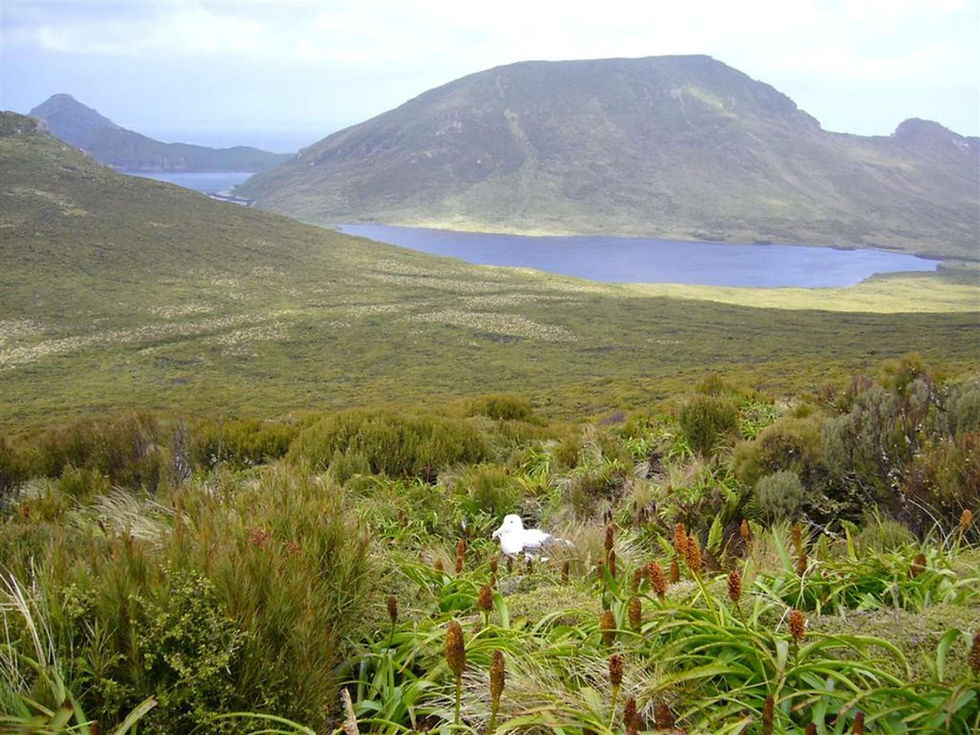
The Bush Wren has the morbid honor of potentially being the most recent bird extinction in Aotearoa. Once one of our most common birds, the loss of habitat and introduced predators like rats and stoats caused this species to decline; they only survived on Taukihepa / Big South Cape Island. Six bush wrens were translocated from Taukihepa to nearby Kaimohu Island by the Wildlife Service in 1964, in a desperate attempt to save the species after the invasion of ship rats on the South Cape islands. Two birds were seen on Kaimohu Island in 1972—the last time this bird was seen alive.
In the branches, we manage to spot a small nest. It looks to belong to a Brown creeper / Pīpipi (Mohoua novaeseelandiae), but one chick is much larger than the others, which shows this nest has been parasitised by the Long-tailed cuckoo / Koekoeā (Eudynamys taitensis). Aotearoa is home to two species of Cuckoos, the Long-tailed cuckoo and the Shining cuckoo / Pīpīwharauroa (Chrysococcyx lucidus).
These cuckoos are migratory, coming to Aotearoa in summer to breed, with the Shining cuckoo wintering in the Bismarck Archipelago (New Guinea) and Solomon Islands, while the Long-tailed Cuckoo winters in the Pacific Islands. They are brood parasites, laying their eggs in the nests of other species and tricking them into caring for the young cuckoo.
The larger and threatened Long-tailed cuckoo lays eggs in the nests of Whitehead / Pōpokotea (Mohoua albicilla) of the North Island, and Yellowhead / Mohua (Mohoua ochrocephala) and Brown creeper in the South Island. The smaller Shining cuckoo, on the other hand, relies on the Grey warbler / Riroriro (Gerygone igata) and Chatham Island warbler (Gerygone albofrontata).
The decline of our forests has a trickle-down effect on species down the line, with less forest habitat for them to use, and with these small songbirds being reluctant flyers, any gap in the forest can prevent them from spreading and cause inbreeding and local extinctions. Less of these songbirds means even fewer nests for these cuckoos to lay in, and as populations of yellowhead and whitehead decline, so does the Long-tailed cuckoo / Koekoeā, showing the indirect impacts on species that rely on these systems.
We begin to slide down the rope as we see a butterfly fly past us, with brown and orange wings. This is a very special butterfly, today the rarest butterfly in Aotearoa: the Forest ringlet / Te pēpepe pōuri (Dodonidia helmsii). Now only found 600 m above sea level, they used to be in lowlands all over, and this has been due to a decline in their host plants due to clearing and the introduced German and common wasps that prey on the caterpillars. Today they are considered a relict species, much less common than they were 1,000 years ago.

As we come back to the ground, we walk through the bush to find another tree to climb, but we hear the crashing of a large animal pushing through the branches, startling a Kererū / New Zealand pigeon (Hemiphaga novaeseelandiae), as we hear the flapping noise of its wings as it darts to avoid the large animal. As it pushes through, its form becomes more clear as the animal's long neck comes over and looks us in the eye, revealing it to be a female Giant Moa (Dinornis), the largest land animal in Aotearoa.
There were two species of these giants, the North Island giant moa / Kuranui (Dinornis novaezealandiae) and South Island giant moa / Moa nunui (Dinornis robustus). Like other species, they were very similar, but the South Island species was slightly heavier, and they had different-shaped skulls. A female moa like her is a massive bird, reaching 2 meters tall (6'7") at the hips and, with its neck raised, up to 3.6 meters or 12 feet, making it the tallest bird to ever live.

They can weigh up to 250 kgs, but another fun thing that sets them apart is their extreme sexual dimorphism, even among the 9 moa species, with the males being one-third the size, with male giant moa reaching 85 kgs.
These moa were our herbivorous megafauna, like deer or elephants in Aotearoa. The 9 moa species, along with other plant-eating birds like giant geese and takahē, were evolving alongside the plants that they ate, causing the plants to develop novel ways to protect themselves unlike the soft-mouthed, cloven-hooved mammals found across the world.
In response, some plants have small leaves and dense branches to defend from browsing, but one tree was in an arms race with these moa. The Lancewood / Horoeka (Pseudopanax crassifolius) goes through two life stages, with the juvenile plants having long, narrow leaves with spikes on the side like a lance, hence lancewood, but once this tree reaches 4 meters tall the leaves become shorter and wider with reduced spikes.


Funny enough, 4 meters is just above the reach of this beautiful girl here, showing how species evolve together, and even though the moa are extinct today, nobody told the Lancewood tree, as it still produces these leaves in defence of now-gone predators.
We manage to find ourselves another tree, shooting up another rope as we climb up Northern Rātā (Metrosideros robusta), and as we climb we spot red flowers in the branches full of nectar for Tūī (Prosthemadera novaeseelandiae) and Bellbird / Korimako (Anthornis melanura). We see a smaller, more unfamiliar bird with black and yellow darting along. When we get a closer look we identify it as a male Hihi / Stitchbird (Notiomystis cincta), while looking like a small honeyeater, its closest living relatives are the saddlebacks / Tieke and Kokako.

These are our smallest honeyeater, often bullied away from nectar by Tui and Bellbirds, and sadly our rarest. They used to be found all around the North Island, but due to introduced rats and habitat loss, they were extinct on the mainland by 1883, with one last population found on Little Barrier Island / Te Hauturu-o-Toi numbering at most 6,000.
Today, small populations have been translocated to places like Kapiti and Rotokare, but a lot of these populations are less than 200 and need supplementary feeding due to competition with other nectar eaters. The recovery of the Hihi seems to be slow going.
As we climb up the Rātā, we hear the squeaks and whistles of a flock of Kāka (Nestor meridionalis). Today is uncommon, with less than 10,000 left, but in this time potentially in the millions. The social gathering feeding on the nectar is short-lived as a flock of larger Kea (N. notabilis) scare them off as the Kaka move on. Kea today number about 3,000–5,000 birds and are only found in the South Island, gaining a reputation as an alpine bird, but this is only part of the story.
Subfossils, or bones becoming fossils, of Kea have been found in the North Island, from the Wairarapa, Hawke's Bay, and even Waitomo in the South Waikato, only 20 minutes away from the Kiwi House. Along with more coastal and lowland subfossils in the South Island, this suggests that their modern alpine range is more due to mammalian predators rather than habitat preference, since unlike Kāka they nest on the ground, which means predators can get to the vulnerable chicks and mum a lot easier. This hunting drove them out of the lowlands and up into the highlands, where there are fewer of these mammals. This, along with more recent actions like human hunting to protect sheep, has caused Kea to decline to the small numbers we have today.

As we place a hand on the bark of the Rātā, we feel a large smooth shape under our hand as it zooms quickly out from under the hand. Taking a closer look under the camouflage, it looks to be a pregnant Duvaucel's / Tohu gecko (Hoplodactylus duvaucelii / tohu). Like the giant skinks down below, these guys are one of the largest geckos in Aotearoa, and one of the largest in the world, reaching lengths of 30 cm and 120 grams in weight.
In the last post we talked about what makes those large skinks vulnerable to predators due to traits like large size, nocturnal habits, etc., but these guys are even worse off since they breed even slower, with geckos giving birth to twins every year and skinks having litters up to 10 in the same time frame, making it difficult to keep up with rats and mustelids. Today Duvaucel's and Tohu geckos are now only found on offshore islands and fenced sanctuaries, unable to cope with introduced mammals.
Another gecko nearby is more exposed, and a large black bird manages to snag it in its beak, and flies to a nearby perch. It seems to be a New Zealand raven (Corvus moriorum). These were among the largest of all the crows, behind the Common raven (C. corax) and Thick-Billed Raven (C. crassirostris), at about a kilo in weight. These guys were related to the Forest raven (C. tasmanicus), Little raven (C. bennetti), and Australian raven (C. coronoides), all Australian species.
Crows and ravens are all pretty similar in behavior, so it is likely that our ravens were like other species, being glossy black, hyper-intelligent omnivores. Most remains come from coastal sites, but they have also been found inland, suggesting that like modern ravens they took advantage of any food source, from scavenging on seals and penguins on the coast, to eating fruit, insects, and small animals in the forests of Aotearoa. Their remains are found in Māori middens, so they were eaten by Māori and likely went extinct due to hunting and loss of seabird and seal colonies.
As we climb down we see a flock of small green birds come and land to eat the Rātā, making lots of noise as the flock lands to feast. A closer look at the head colour reveals it to be an Orange-fronted parakeet / Kākāriki karaka (Cyanoramphus malherbi), a common bird now, but in our time the population is about 400 birds, and they have the honor of being declared extinct twice.

Aotearoa has 2 other Kākāriki species, the Red-crowned Kākāriki (C. novaezelandiae) and Yellow-crowned Kākāriki (C. auriceps), that were common in Aotearoa, but today are only found in restricted areas, offshore islands, and fenced sanctuaries. These birds not only fall prey to introduced predators, they also compete with mice for food. To avoid competition, the three species all live different lifestyles, with Red crowns feeding mostly on the forest floor, yellows in the canopy, and the orange ones feeding in both, but feeding more on invertebrates compared to other species. Even during European settlement they were common and shot in massive numbers to protect orchards. This, along with habitat loss and introduced predators, caused a massive decline, leading them to be a much less common animal in our forests.
As our feet land back onto the forest floor, we decide to move onto the next tree, passing a Pūriri (Vitex lucens) and seeing some large grey birds in them, looking like North / South Island Kokako (Callaeas wilsoni / cinereus). These two species are very similar, both large (50 cm long and 230 grams) grey birds.
They are both quite territorial and defend territories of between 4–25 hectares, and use their singing to defend them, with the kokako having complex songs and often considered the longest and most beautiful call of any birds in Aotearoa. They are relict flyers as well, so like to jump and glide through the forest finding fruits and leaves to eat.
The two species are similar-looking, but their conservation stories are both different and very interesting. The blue-wattled North Island Kokako (Callaeas wilsoni) declined due to habitat clearance and the introduction of ship rats and possums. They managed to persist, but the population became male-heavy due to the nesting females and eggs being hunted, and had low productivity.
Predator control efforts and translocations since have really helped the kokako begin a comeback, and the North Island kokako is considered Nationally Increasing, going from 330 pairs in 1999 to 2,500 today, one of our greatest conservation wins.

The orange-wattled South Island Kokako, or Kōkā (Callaeas cinereus), however, has become almost like a cryptid. These Kōkā spent more time on the ground, making them more vulnerable to introduced predators, and were declining faster than their North Island counterparts, found all through the South Island in the late 1800s until the last sighting was in 1967 and the species was declared extinct.
That stood until 2007, when an accepted sighting near Reefton caused it to be declared “Data deficient” in 2013. Today it is our most mysterious species, with the South Island Kokako Charitable Trust offering 10,000 NZD to anyone that can confirm the species is still surviving. With rediscoveries like the Takahē in 1948 and the Little Spotted Kiwi as recently as 2025, this could be collected very soon and one species can be taken off the long list of extinct birds of Aotearoa.

As we carry on to find more things, we find a large dead tree rotting along our pathway, full of burrowing grubs, wētā, and many other small animals. Then we see small black and orange birds darting along the branch trying to find grubs and berries to eat. These are North / South Island Saddleback / Tīeke (Philesturnus rufusater / carunculatus), a relative of the Kokako.
Once considered the same species, Tieke are another great conservation success story, with the lowest point surviving on offshore islands, with North Island Tīeke (P. rufusater) surviving only on Hen Island (Taranga) off the northeast coast, and South Island Tīeke (P. carunculatus) saved from extinction when 36 were taken from the South Cape islands to Big and Kaimohu Islands, the first time ever that a rescue translocation had prevented a species from going extinct. Today both species have begun to recover, being found on offshore islands and fenced sanctuaries all over Aotearoa, with the South Island population estimated at 2,000 and the North Island population at over 7,000.

We walk further down the log and find two large mainly black birds, with long white-tipped tail feathers. One bird is larger and has a long, slender, decurved 10 cm bill, while the other has a heavier, less-curved bill at 60 cm long, both with small orange wattles. They almost look like different species, but this is actually the most extreme example of sexual dimorphism in the bird world. The title goes to one of New Zealand's most famous extinct birds, the Huia (Heteralocha acutirostris).
The larger, long-beaked bird is the female, and the smaller bird with the stout bill is the male. We are not sure why this evolved, but we think this means the pair would work together to find food, with the male breaking into wood with the stronger beak and the female fishing grubs out with the long beak. Like the Tieke, they mostly fed on invertebrates, but also fruits and leaves. The Huia was endemic to the North Island, and was a monogamous bird like Kokako. They also moved like kokako, rarely flying and preferring to hop and glide through the forest, and using song to defend their large territories.

These birds, like so many others, were "ecologically naive," with little fear of humans. While they did face the same threats as other birds, Huia tail feathers became fashionable in Britain and female Huia beaks were seen as jewellery. Thousands of huia were caught for collectors, zoos, and fashion, both dead and alive, and the Huia started to decline.
Protection measures came in place in the 1890s to protect the remaining huia, but were poorly enforced. Plans to transfer huia to Kapiti and Little Barrier Island reserves never eventuated. A pair captured in 1893 for transfer to Little Barrier was acquired by Walter Buller and sent to Baron Walter Rothschild in England. After all that exploitation, the last Huia sighting was in 1907, being one of the most tragic stories of extinction in Aotearoa, not just due to negligence but due to human greed and lack of action to save our taonga species.
As we carry on the track, we spot a dead Huia, deciding to pick it up to investigate, because the death of these species is made even more tragic due to the extinction of species that rely on them. As we pull back and look through the feathers, we manage to find one of these species, the Huia louse (Rallicola extinctus), a small feather louse that was adapted to living only on the backs of Huia.
There are a few examples of this within Aotearoa, with the Bushwren louse (Philopteroides xenicus) going extinct in the 70s along with its host, and the Little spotted kiwi louse (Rallicola pilgrimi), an example of conservation-induced extinction, driven to extinction when the last 4 Little Spotted Kiwi were captured, treated for parasites, and released onto offshore islands, unknowingly driving the species to extinction.
Often parasites like these have relationships with their hosts spanning millions of years, and some species of birds can have a whole suite of parasites, suggesting the extinction of an animal like a moa or kiwi, a deeply endemic species to Aotearoa, takes a lot more species of specialized parasites with it.
We carry on the search, we see a large pile of sticks up in the branches of a Tōtara (Podocarpus totara), looking to be a very large nest. The tree looks like it would be a hard climb, and we are tired, so we decide to use a drone and fly up to the nest, where we find one little fluffy bird and a very large, grumpy mother Haast's eagle, or Fuller's eagle (Hieraaetus moorei). If the moa were our deer and elephants, then this eagle would have been our tiger or wolf, the largest predator of the forests of Aotearoa.
The Haast eagle was the largest eagle known, with large females weighing up to 18 kilograms, twice the weight of today's largest eagles like the 9 kilo Harpy eagle (Harpia harpyja), 40% the size of the Haast eagle, with a wingspan of 3 meters. What makes it all the more impressive is that its closest relative is the Little eagle (Hieraaetus morphnoides) from Australia, which is 1/15th the size of a Haast eagle.

We think that the ancestors of these eagles were a little eagle that blew over to the South Island around 2 million years ago, when there was a lot more open grassland compared to now. They then increased in size at a rate faster than any living vertebrate. They rose up the food chain quite fast, adapting to eat large birds like our larger rails, ducks, geese, and right up to our Giant Moa species that can weigh 250 kgs, 15 times larger than the eagle itself.
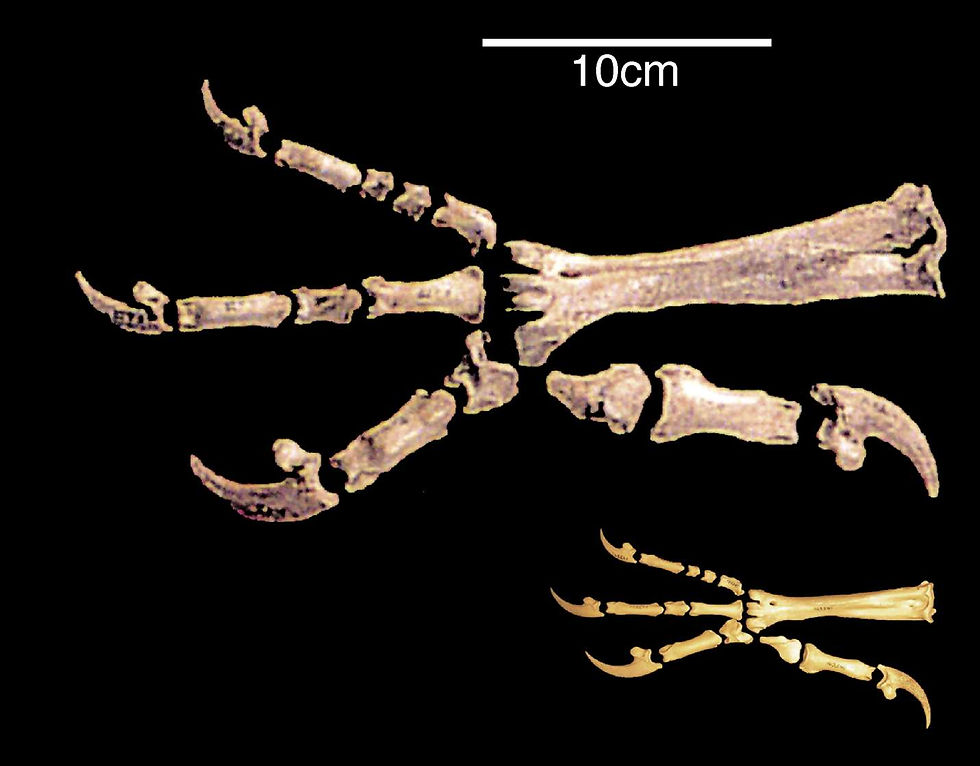
They developed a large, vulture-like skull, bigger than eagles today to help bite and process bigger animals, with an 11 cm beak compared to a 7 cm beak of the largest modern eagles. They also developed massive talons comparable in size to tiger claws to grab onto the pelvis of large birds, even puncturing the pelvic bones of moa. Being large predators needing healthy prey populations, they were never common birds, breeding slowly like other large eagle species. Population estimates put them at about 4,500 breeding pairs across the South Island, making the species vulnerable to extinction.
When the Māori arrived, they became competition, and potential prey, for these eagles. Humans were well in their prey size range, and we have evidence they were hunted by Māori, with Haast eagle bones in middens, using their bones for tools. Along with the burning of habitat and the decline of their prey, this meant that these eagles were most likely one of the first of our birds to go extinct, with top predators often being the first to decline as the food web collapsed under them. We decide to leave the scowling mother to her matters and fly the drone back to earth.
With the sun coming down, a new cast of birds comes out in the night as we make our way to a tall Rimu (Dacrydium cupressinum), shooting a rope up to climb as we hear the skraaks and chings of a Kākāpō (Strigops habroptilus). The rimu here is covered in red berries, filled with nutrients vital to help kakapo prepare to breed after 4 years of waiting.

In this time, Kākāpō were one of our most common birds, found in forests and grasslands all over Aotearoa, with subfossil deposits and middens showing they were found in habitats all over New Zealand. When Māori arrived, they were hunted for food and their feathers for cloaks, and with the burning of the forests and the introduction of Kiore, their populations began to decline.
By the time Europeans arrived in Aotearoa, they were already relics of their former ranges. They ramped up logging and introduced more mammals like stoats and cats, causing their populations to plummet until they went extinct in the North Island in the 1930s and the South Island in the 1980s.
Luckily, a population persisted in 1977 on Stewart Island / Rakiura, and some last surviving South Island males were transferred to Whenua Hou / Codfish Island to keep the population safe from cats. From the 50 founders, with intensive management, the slow-breeding kakapo are now at 250, with 100 chicks in the 2025/6 breeding season. While it is slow going, Kakapo are recovering and returning to places they once lived.
We then feel the movement of something large climbing up our arm, and as we look down to check we see the shape of a Wētāpunga (Deinacrida heteracantha), one of the largest insects in the world, and at 40 grams, one of the most amazing creatures found in Aotearoa.
The genus Deinacrida has about 11 different species, ranging from the tree-dwelling ones like Wētāpunga and Mahoenui giant wētā (D. mahoenui), to ground-dwelling species like the Cook Strait giant wētā (D. rugosa), and even alpine species like the Mt Arthur giant wētā (D. tibiospina). Today, like our large geckos and skinks, they are restricted to offshore islands or small pockets of habitat.

Being large, nocturnal insects, they are the most likely to encounter rodents, with the young nymphs easily becoming prey, getting to the point where species like the Mahoenui giant wētā are now only restricted to the Mahoenui Giant Wētā Scientific Reserve, a patch of gorse, an introduced plant, in the South Waikato. These species have been increasing due to captive rearing programs at facilities like the Otorohanga Kiwi House, Butterfly Creek, and Auckland Zoo, releasing them to fenced-off areas on offshore islands to help establish new populations safe from introduced mammals.
As we make our way back down and out of the forest, it’s hard not to notice what’s missing.
What we’ve just moved through—from the forest floor to the canopy—was once continuous across Aotearoa. A vast, interconnected system of life, stretching from coast to mountain, where species moved freely and relationships held the forest together.
But much of that forest is gone.
Cleared, burned, logged, and fragmented by Māori and then Europeans, what was once over 80% forest cover has been reduced to scattered remnants. Great trees like the impressive Kauri have declined to 90% of what they once were. Timber was a major export in the 1840s, and other parts of the island were burned just to produce area for farmland and land to grow crops.
That loss didn’t just come from fewer trees—but fewer connections. Fewer nesting sites, fewer feeding grounds, fewer pathways for species to hide and survive.
For birds that don’t fly far, even a gap in the forest can be the difference between survival and extinction.
What we’ve seen today isn’t just a story of what lived here.
It’s a story of what was lost—and what still remains.
Because despite everything, parts of this system are still here. In protected forests, offshore islands, fenced sanctuaries, and in the work being done every day to restore what we can.
The canopy is thinner now. The voices are quieter.
But they are not gone.
And if we choose to, they don’t have to be.
References
Home page | New Zealand Birds Online. (n.d.). Www.nzbirdsonline.org.nz. https://www.nzbirdsonline.org.nz/
de Lange, P.J. “Agathis Australis.” New Zealand Plant Conservation Network, www.nzpcn.org.nz/flora/species/agathis-australis/.
Knight, Jacqui. “Dodonidia Helmsii - Moths and Butterflies of New Zealand Trust.” Moths and Butterflies of New Zealand Trust, 27 Aug. 2022, www.nzbutterflies.org.nz/species-info/forest-ringlet/.
“Hoplodactylus Duvaucelii | NZHS.” Reptiles.org.nz, 2016, www.reptiles.org.nz/herpetofauna/native/hoplodactylus-duvaucelii.
Rózsa, Lajos, and Zoltán Vas. “Co-Extinct and Critically Co-Endangered Species of Parasitic Lice, and Conservation-Induced Extinction: Should Lice Be Reintroduced to Their Hosts?” Oryx, vol. 49, no. 1, 22 Aug. 2014, pp. 107–110, https://doi.org/10.1017/s0030605313000628.
Trewick, Steve, et al. Conservation Status of Orthoptera (Wētā, Crickets and Grasshoppers) in Aotearoa New Zealand, 2022. 2022. https://www.doc.govt.nz/globalassets/documents/science-and-technical/nztcs39entire.pdf